retail
How Rug Retailers Are Using AI to Run Their Whole Store From One App
By Octa Notes, Product & Notes, Octabiz
· 6 min read
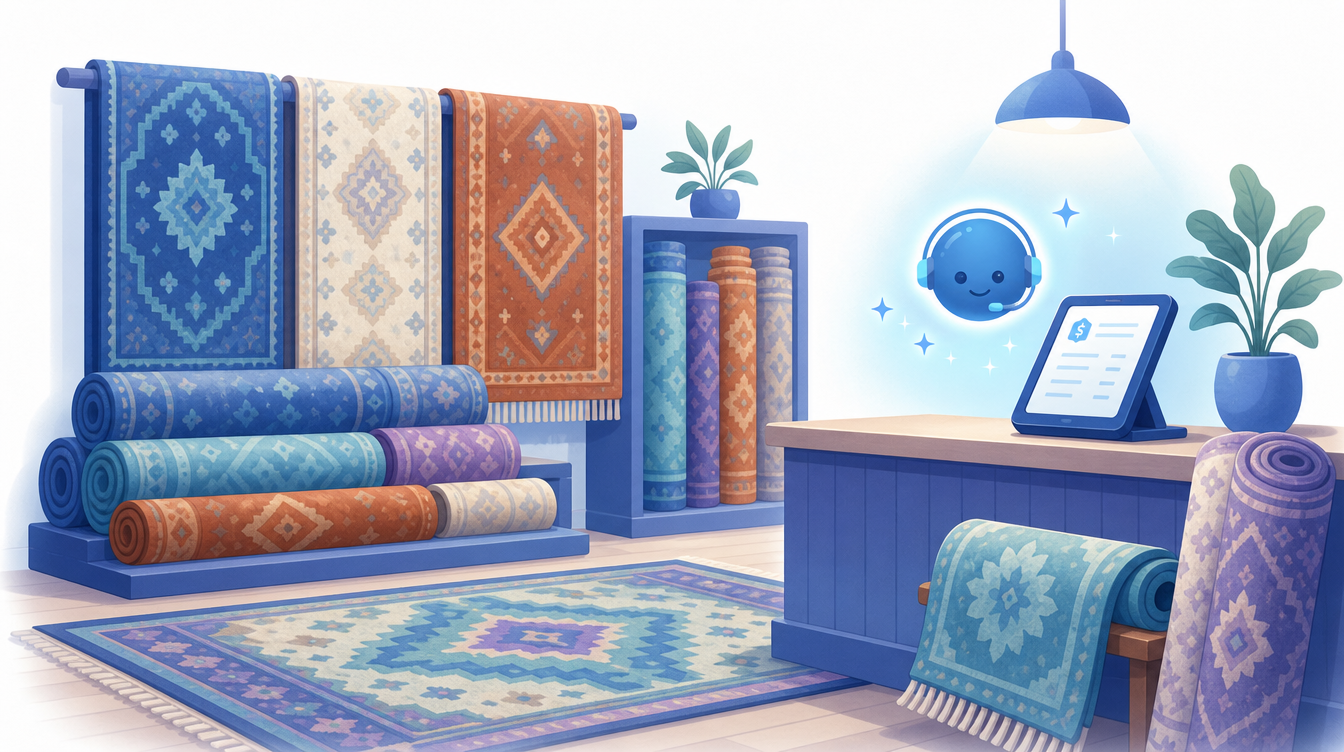
Walk into most independent rug and flooring stores and you'll find the same stack: a cash register or card reader for ringing up sales, a spreadsheet or paper log for inventory, a shoebox (or a separate app) for customer follow-up, and a bookkeeper who gets a pile of receipts once a month. None of it talks to each other, and the owner is usually the one stitching it together at night.
Rug retail is a big, resilient category. The global carpet and rug market is on track to grow from $52.6 billion in 2024 to $125.7 billion by 2034, but it's still overwhelmingly a showroom business. 81.3% of carpet and rug sales still happen offline, because buyers want to see the pile, feel the weave, and lay a sample next to their own furniture before they spend a few hundred, or a few thousand, dollars. That makes the point-of-sale counter, not a website, the place where most rug retailers actually run their business.
:::chart type="donut" title="How rug and carpet sales actually happen" label="Chart" caption="81.3% of 2024 carpet and rug sales happened in-store. The online share shown here is the remainder of that same two-channel breakdown." source="Market.us, Carpet and Rug Market report, March 2025"
- In-store / offline | 81.3% | share of sales
- Online | 18.7% | share of sales :::
Octabiz is built to be the one app that runs that whole counter: sales, inventory, customers, and books, with AI handling the parts that used to eat an owner's evening.
:::takeaways title="The short version"
- Octabiz replaces the register, the inventory spreadsheet, the customer follow-up list, and the bookkeeping software with one connected app.
- A daily AI Cash Flow Coach flags slow-paying customers and upcoming bills before they become a problem. That's useful for a business built on big-ticket, sometimes financed purchases.
- The Voice Assistant lets a salesperson check stock, pull up a customer's order history, or draft an invoice hands-free, without leaving the customer's side on the showroom floor.
- The AI Tax Assistant keeps sales-tax-heavy retail books filing-ready year-round instead of a scramble every quarter. :::
One app instead of ten
Most small businesses don't run on one system. They run on several that don't talk to each other. Intuit's own research found the average small business uses about 10 different digital tools to manage its operations, and because those tools aren't connected, owners lose time re-entering the same sale, the same customer, and the same expense in three different places.
For a rug store, that disconnection shows up in specific ways: a sale rung up at the counter that doesn't update the inventory count, a custom order that never makes it into a follow-up list, a big-ticket sale that doesn't hit the books until the owner catches up on data entry weeks later. Octabiz combines point of sale, inventory, CRM, accounting, HR, and marketing into a single connected workspace, so a sale on the floor updates stock, opens the invoice, and logs the customer in the same motion.
That connection also pays off on the customer side, which matters more in a category like rugs than in most retail. A rug purchase is rarely a single-visit, single-item transaction: it's a browse, a quote, a measurement, sometimes a financing conversation, and a follow-up months later for a second room or a matching runner. Research from Bain & Company, via Harvard Business Review, found that increasing customer retention by just 5% can increase profits by 25% to 95%, and that acquiring a new customer typically costs five to 25 times more than keeping an existing one. A CRM that actually remembers who bought what, and when to follow up, is worth more in a business like this than in one selling low-cost, one-time items.
Where AI takes the busywork off the sales floor
Octabiz's AI tools are built into the workspace at no extra cost, and each one targets a specific piece of the admin load that otherwise falls on the owner or the sales staff.
The Voice Assistant runs as a floating helper across the app. A salesperson standing with a customer next to a 9x12 wool rug can ask it to check whether a matching runner is in stock, pull up whether that customer bought from the store before, or draft the invoice on the spot, all by talking, without stepping away to a back-office computer. Administrative tasks like invoicing and data entry eat an estimated 36% of the average small business owner's workweek, and handling them at the point of sale, instead of after close, gives that time back.
Mornings start with the Cash Flow Coach: a one-minute briefing on cash position, expected receipts, upcoming bills, and, notably for a business with big-ticket and financed sales, which customers are slipping on payment terms. Rug retail carries real seasonality and lumpy revenue (a slow week followed by three large custom orders closing at once), which is exactly the pattern a daily cash briefing is built to catch early.
Sales tax is where the AI Tax Assistant earns its keep. It keeps books tax-ready continuously instead of at filing time, drafting quarterly filings and flagging transactions that are missing a receipt or tax code. Retail carries sales tax complexity that service businesses don't: multiple product categories, exemptions, and rates that vary by jurisdiction, so keeping that clean year-round beats reconstructing it every quarter.
This pattern of AI handling the paperwork around getting paid isn't unique to Octabiz. It's showing up across small business software generally. Intuit reported that QuickBooks customers using AI-drafted invoice reminders got paid 45% faster, an average of five days sooner, and that overdue invoices handled this way were 10% more likely to be paid in full. It's a useful data point for any rug retailer still sending payment reminders by memory: the software category has already shown this works, and it's now part of what a connected retail platform can do automatically.
What this looks like day to day
For a rug retailer, that adds up to a specific shift: instead of closing the register, then updating a spreadsheet, then checking who still owes money, then handing a shoebox of receipts to a bookkeeper once a month, the sale, the stock count, the customer record, and the books update together, and the parts that used to require remembering (following up on a quote, catching a slow-paying customer, keeping sales tax current) happen automatically in the background.
Octabiz is built for small and medium businesses across retail, restaurants, hotels, and home services, with rug and flooring stores fitting squarely into the retail side: inventory-heavy, showroom-driven, and built on repeat and referral customers more than any single transaction.
:::stats title="The numbers behind this"
- $52.6B → $125.7B | global carpet and rug market size, 2024 to a projected 2034, a 9.1% CAGR, per Market.us
- 81.3% | share of carpet and rug sales that happen offline, in-store, rather than online, per Market.us
- 25% to 95% | profit increase from a 5-percentage-point improvement in customer retention, per Bain & Company research cited by Harvard Business Review
- 5x to 25x | how much more expensive it typically is to acquire a new customer than to retain an existing one, per the same Bain/HBR research
- 45% faster, ~5 days sooner | how much faster invoices got paid using AI-drafted reminders, per Intuit's reporting on QuickBooks customer data
- 36% | share of an average small business owner's workweek spent on administrative tasks like invoicing and data entry, per Time etc :::
References
- Carpet and Rug Market Size, Share: Market.us, March 2025
- The Value of Keeping the Right Customers: Harvard Business Review, citing Frederick Reichheld / Bain & Company
- Intuit Launches AI-Powered Intuit Assist for QuickBooks: Intuit Inc. investor press release, November 2024
- The Big Price of Small Tasks: Time etc, survey of entrepreneurs' administrative time
Octabiz is an AI-powered all-in-one business platform combining point of sale, accounting, inventory, CRM, HR, and marketing tools, built for small and medium businesses in restaurants, hotels, retail, and home services.